Universal menu

  • Global
  • Regions
    • Africa
    • Americas and the Caribbean
    • Arab States
    • Asia and the Pacific
    • Europe and Central Asia
  • Knowledge
  • Data
  • Training
  • Transparency
UN Women - For all women and girls

Main Navigation-HQ

  • Who we are
    • About us
      • About UN Women
      • Business model
      • Guiding documents
      • Worldwide presence
    • Leadership
      • Governance structure
      • Executive leadership
      • Executive Board
      • Accountability
    • Work with us
      • Employment
      • Procurement
      • Calls for proposals
      • Contact us
      • UN Women Strategic Plan 2026–2029
      • UN Women Strategic Plan 2026–2029 - social media image
        UN Women Strategic Plan 2026–2029
  • What we do
    • Focus areas
      • Ending violence against women
      • Peace and security
      • Humanitarian action
      • Leadership and governance
      • Economic empowerment
      • Innovation and technology
      • Women with disabilities
      • Youth
      • HIV and AIDS
    • How we work
      • 2030 Agenda for Sustainable Development
      • Commission on the Status of Women
      • Gender parity in the UN system
      • Intergovernmental support
      • Partnerships
      • Research and data
      • Training Centre
      • Trust funds
      • UN system coordination
      • Gender Equality Accelerators
      • Gender Equality Accelerators artwork
        Gender Equality Accelerators
  • News and stories
    • Latest
      • News
      • Articles and explainers
      • In focus
    • Media center
      • Press materials
      • Media contacts
      • Explainer: Why are women so exhausted? Care work and the mental load
      • Two adults stand at a table changing diapers on baby dolls, with laundry hanging on a clothesline behind them in a home setting.
        Explainer: Why are women so exhausted? Care work and the mental load
      • Press release: Aid cuts dismantle women’s organizations working in humanitarian crises
      • A young Ugandan woman sits with another local woman to talk
        Press release: Aid cuts dismantle women’s organizations working in humanitarian crises
  • Digital library
    • Resources
      • Publications
      • Annual reports
      • Gender snapshot
      • Progress of the world’s women
      • World survey on the role of women in development
    • GenderTerm
      • GenderTerm
      • Reprint permissions
      • UN Women Highlights 2025–2026
      • A smiling woman.
        UN Women Highlights 2025–2026
      • Gender snapshot 2026
      • A diverse group of people represented as simplified silhouettes, arranged against a dark blue background.
        Gender snapshot 2026
  • Get involved
    • How to get involved
      • For ALL Women and Girls
      • International Women's Day
      • 16 Days of Activism to End Violence against Women and Girls
      • UNiTE! Campaign to End Violence against Women
      • Generation Equality
      • He for She
Ask AI
https://84e5cfacd5c7e99f9825edf344450c.1b.environment.api.powerplatform.com/powervirtualagents/botsbyschema/crad4_websiteQA/directline/token?api-version=2022-03-01-preview
1
-
Ask your question here
AI website assistant

Hello, how can I assist you?

AI chatbot responses may be incorrect. Always verify important information.

Donate button menu

Donate

Breadcrumb

  1. Home
  2. Publications

Website survey

We want to know how we can improve your experience on this website. Completing this survey takes less than 5 minutes.

TAKE THE SURVEY
Image
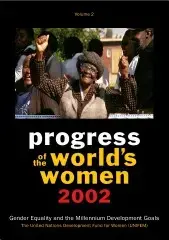
Progress of the World's Women 2002, Volume 2: Gender Equality and the Millennium Development Goals

Progress of the World's Women 2002, Volume 2: Gender Equality and the Millennium Development Goals

Publication year 2002
  • Share to Facebook
  • Share to Twitter
  • Share to LinkedIn
  • Share to E-mail
Author(s)/editor(s) Diane Elson (University of Essex) Hanke Keklik (UNIFEM)

There are more than 140 million illiterate young people in the world; more than half (86 million) are women. This is one example of why 189 nations adopted women's empowerment and gender equality as one of the eight Millennium Development goals set during the 1990s. The publication "Progress of the World's Women 2002" quantifies country-by-country progress (or lack thereof) towards meeting these goals.

"Progress of the World's Women 2002: Volume 2: Gender Equality and the Millennium Development Goals" is the second edition of a biennial publication first produced in 2000 to track and measure the world's commitment to gender equality. It assesses improvements made towards women's empowerment within the context of the Millennium Development Goals, a set of eight goals created by the international community in 2000 to focus global efforts to end poverty, hunger and inequality. Analyzing the indicators for Goal 3 - 'Promote gender equality and empower women' - "Progress 2002" examines progress for women, or the lack of it, in education, literacy, non-agricultural wage employment and parliamentary representation.

"Progress 2002" indicates that women are still primarily absent from parliaments. Furthermore, the report also shows that unlike the other indicators of progress which illustrate differences between wealthy and poor countries, there are no such differences in terms of women's participation in national governments. "Progress 2002" also provides basic targets for the year 2000 include primary education for 80% of school-age children, life expectancy not less than 60 years in any country, and maternal mortality reduced by one-half of the 1990 levels. These targets, as well as future goals such as closing the gender gap in secondary education and the employment market are examined. "Progress of the World's Women 2002" charts these and other areas, ranking each country in terms of gender achievement.

Gender equality and the empowerment of women are important factors in combating poverty, hunger and disease and stimulating development that is truly sustainable. "Progress of the World's Women 2002" provides a snapshot of the state of women's lives and how much further we have to go to achieve equality.
View online/download

  • Cover
  • Table of Contents
  • Acknowledgements
  • Preface
  • Introduction: Progress of the World's Women
  • Section I: Assessing Progress in Achieving Gender Equality (Part 1)
  • Section I: Assessing Progress in Achieving Gender Equality (Part 2)
  • Section II: Innovations in Measuring and Monitoring
  • Conclusion: Moving Forward
  • Technical Notes and References
  • Media Kit: Press Release
  • Media Kit: Overview
  • Media Kit: Findings and Recommendations
  • Media Kit: Authors' Bios

Order printed/published version

Languages available in print
English
Unit price
USD 16.95
Shipping fee
USD 0.00

Bibliographic information

Number of pages
72
Resource type(s)
Assessments
ISBN
0-91291770-9
Publishing entities
United Nations Entity for Gender Equality and the Empowerment of Women (UN Women)
UN Women office publishing
UN Women Headquarters Office

Tags

Gender equality and inequality Gender equality and women’s empowerment

Related publications

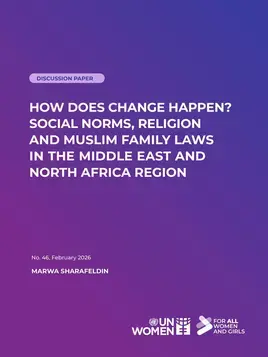
How does change happen? Social norms, religion and Muslim family laws in the Middle East and North Africa region

How does change happen? Social norms, religion and Muslim family laws in the Middle East and North Africa region

3 February 2026
Discussion-paper-Social norms, religion and Muslim family laws in the Middle East and North Africa region
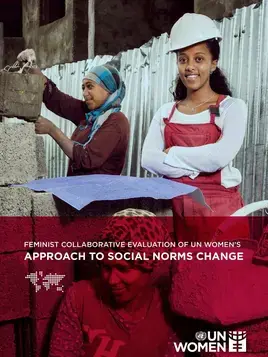
Feminist collaborative evaluation of UN Women’s approach to social norms change

Feminist collaborative evaluation of UN Women’s approach to social norms change

20 November 2024
Evaluation-Feminist collaborative evaluation of UN Women’s approach to social norms change
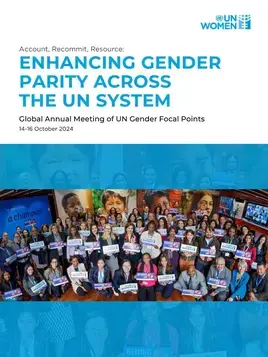
Account, recommit, resource: Enhancing gender parity across the UN system

Account, recommit, resource: Enhancing gender parity across the UN system

14 November 2024
Account, recommit, resource: Enhancing gender parity across the UN system

Footer menu-HQ

  • News and stories
  • Resources
  • What we do
  • How we work
  • Where we are
  • Partnerships
  • Employment
  • Procurement
  • Contact us
  • Executive Board
  • Commission on the Status of Women

Donate button menu [Footer tablet]

  • Donate

Donate button menu [Footer]

  • Donate

Social media menu

  • Facebook
  • Twitter
  • LinkedIn
  • Flickr
  • YouTube
  • Instagram
UN Women - For all women and girls

Footer bottom [Menu]

  • Copyright
  • Information security
  • Privacy notice
  • Report wrongdoing
  • Terms of use
Share this page
  • Share to Facebook
  • Share to Twitter
  • Share to LinkedIn
  • Share to E-mail

Or copy link