
Universal menu

  • Global
  • Regions
    • Africa
    • Americas and the Caribbean
    • Arab States
    • Asia and the Pacific
    • Europe and Central Asia
  • Knowledge
  • Data
  • Training
  • Transparency
UN Women - For all women and girls

Main Navigation-HQ

  • Who we are
    • About us
      • About UN Women
      • Business model
      • Guiding documents
      • Worldwide presence
    • Leadership
      • Governance structure
      • Executive leadership
      • Executive Board
      • Accountability
    • Work with us
      • Employment
      • Procurement
      • Calls for proposals
      • Contact us
      • UN Women Strategic Plan 2026–2029
      • UN Women Strategic Plan 2026–2029 - social media image
        UN Women Strategic Plan 2026–2029
  • What we do
    • Focus areas
      • Ending violence against women
      • Peace and security
      • Humanitarian action
      • Leadership and governance
      • Economic empowerment
      • Innovation and technology
      • Women with disabilities
      • Youth
      • HIV and AIDS
    • How we work
      • 2030 Agenda for Sustainable Development
      • Commission on the Status of Women
      • Gender parity in the UN system
      • Intergovernmental support
      • Partnerships
      • Research and data
      • Training Centre
      • Trust funds
      • UN system coordination
      • Gender Equality Accelerators
      • Gender Equality Accelerators artwork
        Gender Equality Accelerators
  • News and stories
    • Latest
      • News
      • Articles and explainers
      • In focus
    • Media center
      • Press materials
      • Media contacts
      • Explainer: Why are women so exhausted? Care work and the mental load
      • Two adults stand at a table changing diapers on baby dolls, with laundry hanging on a clothesline behind them in a home setting.
        Explainer: Why are women so exhausted? Care work and the mental load
      • Press release: Aid cuts dismantle women’s organizations working in humanitarian crises
      • A young Ugandan woman sits with another local woman to talk
        Press release: Aid cuts dismantle women’s organizations working in humanitarian crises
  • Digital library
    • Resources
      • Publications
      • Annual reports
      • Gender snapshot
      • Progress of the world’s women
      • World survey on the role of women in development
    • GenderTerm
      • GenderTerm
      • Reprint permissions
      • UN Women Highlights 2025–2026
      • A smiling woman.
        UN Women Highlights 2025–2026
      • Gender snapshot 2026
      • A diverse group of people represented as simplified silhouettes, arranged against a dark blue background.
        Gender snapshot 2026
  • Get involved
    • How to get involved
      • For ALL Women and Girls
      • International Women's Day
      • 16 Days of Activism to End Violence against Women and Girls
      • UNiTE! Campaign to End Violence against Women
      • Generation Equality
      • He for She
Ask AI
https://84e5cfacd5c7e99f9825edf344450c.1b.environment.api.powerplatform.com/powervirtualagents/botsbyschema/crad4_websiteQA/directline/token?api-version=2022-03-01-preview
1
-
Ask your question here
AI website assistant

Hello, how can I assist you?

AI chatbot responses may be incorrect. Always verify important information.

Donate button menu

Donate

Breadcrumb

  1. Home
  2. News and stories
  3. Feature story

Website survey

We want to know how we can improve your experience on this website. Completing this survey takes less than 5 minutes.

TAKE THE SURVEY
Feature

How aid cuts are threatening women’s organizations responding to Haiti’s gang violence

As armed gangs expand their control, women-led organizations are providing critical support to survivors of violence and displacement, negotiating for humanitarian access, and supporting peacebuilding. Sweeping aid cuts put their work at risk.

6 August 2026
  • Share to Facebook
  • Share to Twitter
  • Share to LinkedIn
  • Share to E-mail
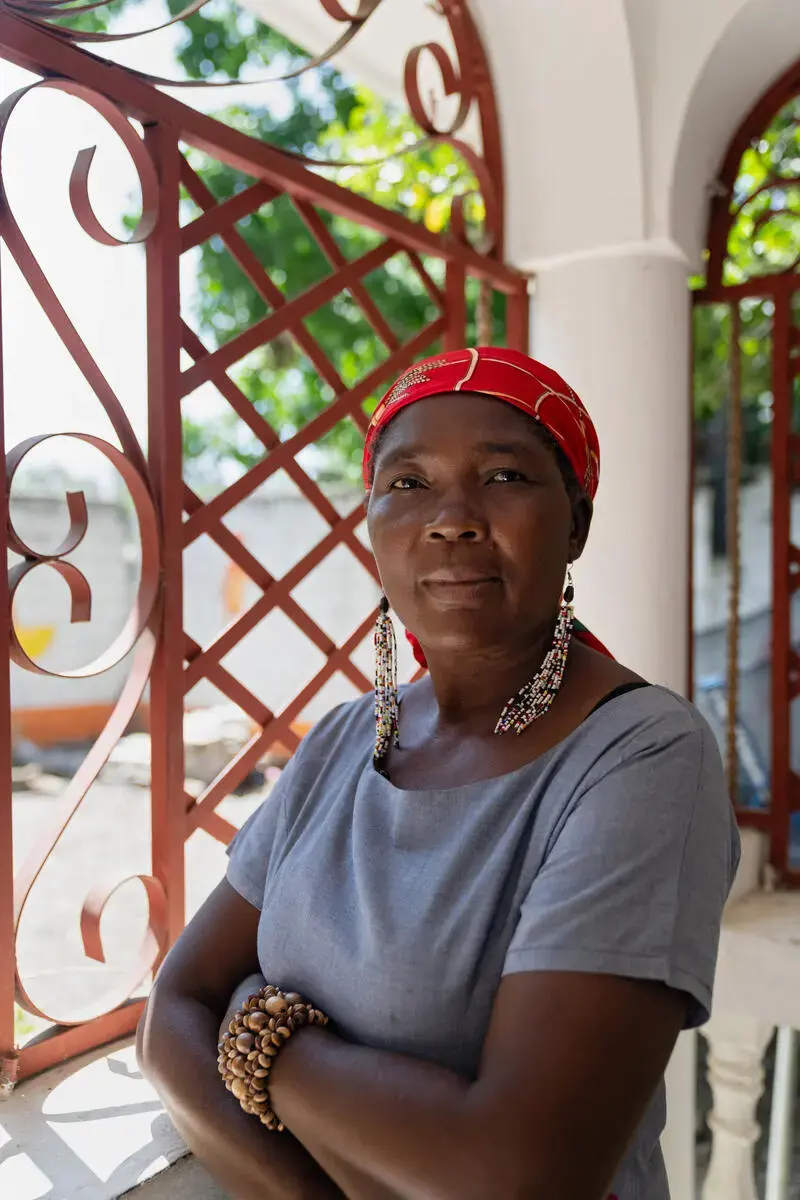
Roselene Pierre, President of the Rassemblement des Femmes Engagées de Ouanaminthe (RFEO), is on call 24/7 in the border town of Ouanaminthe in northeastern Haiti. Known throughout the community, Pierre works day and night with her team to uphold the rights of women and children, providing lifesaving support, and creating opportunities for women to earn a living. Photo: UN Women/Jess DiPierro Obert

Basic Hero Banner

Armed gang violence has exploded in Haiti in recent years. Once largely concentrated in Port au Prince, armed gangs have expanded their control across the country, bringing with it violence and insecurity.

The impact on women and girls has been particularly devastating. Some 790,000 women and girls are among nearly 1.47 million people who have been forced to flee their homes. Gang members are using sexual violence as a tactic to terrorize, exploit and extort women and girls, and their communities. Homes and businesses have been burned to the ground, or taken over by the gangs, and more than 1,600 schools have been forced to close. Healthcare and legal services have been decimated – all at a time when the need for them is colossal.
Image
A portrait of a woman wearing a red headscarf and beaded earrings.

Women are beaten, there is sexual violence against women, and women are dying.

—Roselene Pierre, President of the Rassemblement des Femmes Engagées de Ouanaminthe (RFEO)

Roselene Pierre is the President of Rassemblement de Femmes Engagées de Ouanaminthe (RFEO), an organization supported by UN Women that provides around the clock assistance to women and children in northeast Haiti. Every day, Pierre sees what women and girls in her community experience: “Women are beaten, there is sexual violence against women, and women are dying”, she says.

RFEO was founded by Pierre and her two close friends almost 20 years ago to respond to these urgent needs. Today the organization’s support is in high demand. Alongside escalating gang violence that has forced families to flee their homes and communities, Haitians returning from the Dominican Republic, just across the border, have faced aggressive deportations. RFEO provides a holistic package of support to deportees and survivors of violence.

“It is a complete package”, explains Pierre. “We welcome them, we register them, we provide temporary shelter, we provide hygiene kits, clothing, underwear, and means of transportation… And then we provide psychological support”.

How aid cuts are hurting women’s organizations responding to Haiti’s gang violence

Beyond addressing immediate needs, RFEO’s support is centred on creating lasting change for women and children. The organization offers family mediation services, community groups for children, and opportunities for women to earn an income. Many people are forced to flee their homes carrying nothing but trauma. Through vocational training and cash assistance, RFEO empowers women to set up their own small businesses, helping them rebuild what the violence stole from them.

Women and girls also bring with them most of the caregiving responsibilities and the household financial burden. This pressure can push women to breaking point.

Emmanuela fled her home in Mirebalais with her grandpa and hundreds of her neighbours. She hid out in the forest for weeks before reaching a displacement site in Fort Liberte, northeast Haiti. She explains what some women are faced with: “Some have children, and when the kids cry, they have to sell their bodies to take care of them.”

Image
A group of women sit together in a circle during a community meeting.
Fania Finfin, President of the Groupe Féministe Révolté d'Haïti (GFRD), leads a women’s support group with her colleague in Ouanaminthe, northeast Haiti. GFRD works to uphold the rights of women and girls, providing a full spectrum of support from prevention and protection against gender-based violence, advocating for social justice, women’s rights, peacebuilding, and mediation. Photo: UN Women/Jess DiPierro Obert

How armed gangs in Haiti exploit poverty, displacement, and women and girls

Latest UN Women data show that more than 80 per cent of women living in displacement sites are unemployed. Gangs are exploiting their poverty and displacement and using threats to coerce women and girls into joining, and serving, gangs.

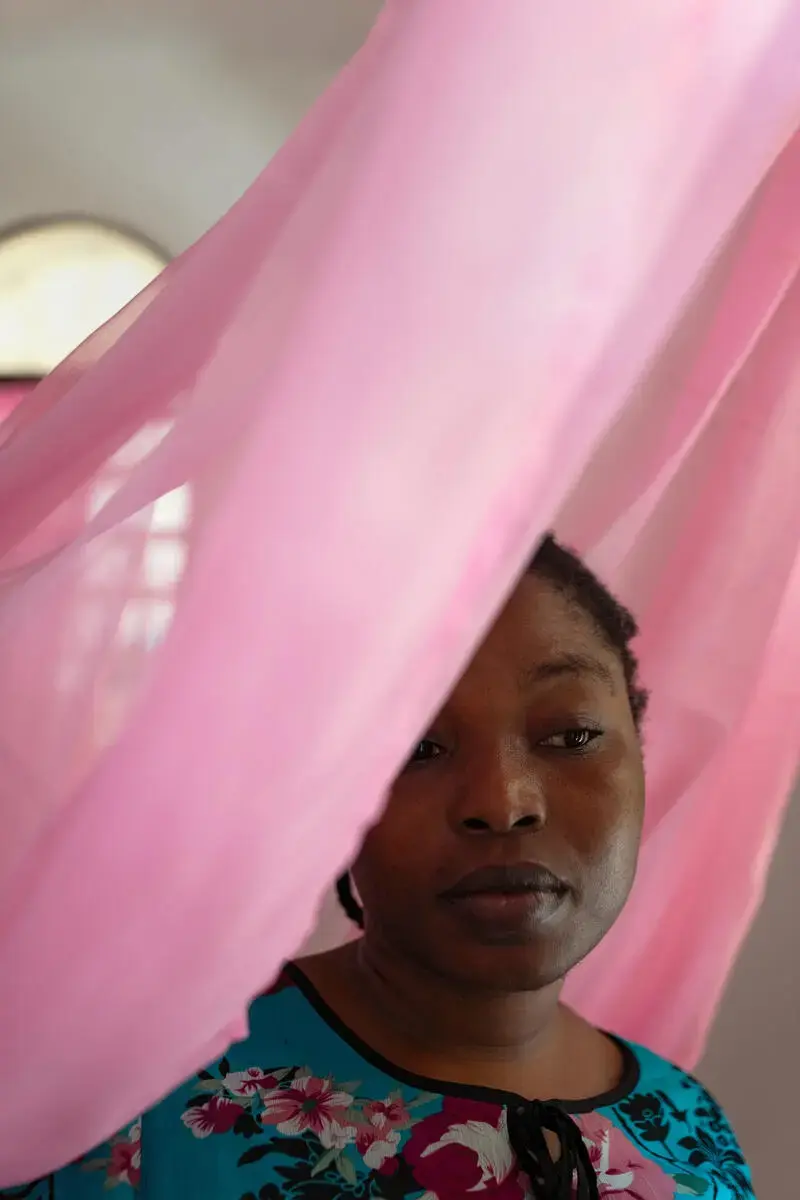
Katiana fled Port-au-Prince last year after gangs took over her neighbourhood and shot and killed her friend and neighbour in front of her. She sought shelter in Ouanaminthe and has since received support from RFEO including psychological support, training and cash assistance.
Image
A woman looks through sheer pink fabric draped around her.

There are some women who are raped and forced to be the wives of some of these gang leaders… If I was still there, I can’t imagine what could have happened to me

—Katiana

Women-led organizations are helping survivors rebuild their lives and communities

Loudmia, 43, fled Port au Prince last year when the gangs took over her neighbourhood, burned down her home and took everything she had.

“I lost my brother. I lost my cousin. I lost my aunt. And I lost my friends, many people”, says Loudmia “They shot them, set them on fire. They burned their houses.” Loudmia faced severe trauma and sought refuge in Ouanaminthe. She was brought to RFEO by one of her friends who saw her living on the streets with her three children.

She describes the support as lifesaving: “It was because of this friend who brought me to RFEO that today I am here. I am living.” Loudmia takes part in counselling sessions and has received a small cash grant.

“They talk to me about what life is. How I can recover my memories, so that I do not keep the shock in my head all the time, inside myself, so that I do not think about it all the time.” She describes how she feels about Roselene Pierre: “I would consider her a queen. After God, I would consider Madame Roselene from RFEO as a queen”.

Image
A group of people sit around a table during a meeting.
Régine Zéphirin Diègue (centre), founder of the Mouvement pour l’Intégration et l’Émancipation des Femmes Handicapées (MIEFH), meets with members of her team at the organization’s offices in Cap-Haitien. Photo: UN Women/Jess DiPierro Obert

Aid cuts are threatening women-led humanitarian and peacebuilding efforts in Haiti

Just as needs are increasing, the support RFEO provides is at risk due to funding cuts that have swept through the aid sector.

RFEO is among many organizations that have been forced to reduce its paid staff, forcing it to reduce the number of women and children the organization can reach. UN Women surveyed women’s organizations in Haiti to understand how aid cuts have impacted their work. 83 per cent report losing staff, and around two-thirds say they were forced to delay or suspend services to support survivors of gender-based violence.

Meanwhile, 97 per cent report that their capacity to provide services is lower than the current need, and 1 in 3 expects to suspend operations or close entirely within the next 12 months. Often, already marginalized women, girls and their communities are the hardest hit.

Régine Zéphirin Diègue, founder of the Movement for the Integration and Emancipation of Disabled Women (MIEFH), Haiti’s first organization dedicated to empowering women and girls with disabilities, has been hit hard. In early 2025, MIEFH lost three-quarters of its paid staff due to funding cuts.

By the following week, the entire team returned as unpaid volunteers. This was a testament to their commitment but an unsustainable measure. “If MIEFH’s situation worsens, unfortunately we’ll have to close”, explains Diègue. “I have staff, who for some time now are working pro bono. You can’t ask them to volunteer indefinitely.”

According to Diègue, the escalation of gang violence has increased the risks faced by women and girls with disabilities: “Since 2024, there are so many displaced people, who are staying with friends and family – the people hosting them feel like they have all their rights because they are providing a little food or place to sleep. Sometimes because the other person is asking them for help, it becomes transactional.”

Image
A smiling woman leans on a porch railing beside a girl in a pink dress.
Philonia smiles at her 13-year-old daughter at their home in Cap-Haïtien, Haiti. Her daughter Marie-Claude loves to dance and listen to music. She has a learning disability and has struggled to advance past first grade. “For girls who are handicapped or have handicapped children, don’t give up. Keep your children close and strong”, says Philonia. Photo: UN Women/Jess DiPierro Obert

For girls with disabilities, women’s organizations mean the chance to go to school

Philonia is street vendor and single mother raising three children in Cap-Haitien. Her daughter, Marie-Claude, has a learning disability. “She’s 13 years old. She is still in the first grade and can't move forward. It’s very worrisome for them and me.”

“You can’t choose to keep them out of school based on a disability”, she says. “You have to always support her, so that she feels that she is a part of society too. But you know, in Haiti, it is not so easy. We have to take life as it is.”

Support from MIEFH has eased some of the financial burden and psychological toll, enabling Philonia to earn an income. MIEFH also provided notebooks, pencils, and pens for the children when school began. For Philiona, this assistance means her daughter can stay in school, and she can provide for her family.

Women’s organizations are the lifeblood of the humanitarian response and peacebuilding efforts in Haiti. They are negotiating with armed gangs for humanitarian access, providing support to survivors, ensuring women can earn a living, and mediating with communities to prevent a further escalation of violence. Without them, communities across Haiti would lose a deeply trusted source of support, and in many ways, a lifeline.

Image
A woman walks along a residential street with two UN Women staff members.
Philonia walks with UN Women staff in Cap-Haïtien, Haiti. Through the Mouvement pour l’Intégration et l’Émancipation des Femmes Handicapées (MIEFH), Haiti's first organization dedicated to women and girls with disabilities, Philonia received support to start a fruit and vegetable business while also accessing services to help care for and advocate for her daughter. UN Women supports women-led organizations like MIEFH all over Haiti, delivering critical services to women and girls. Photo: UN Women/Jess DiPierro Obert

What is UN Women doing to support women and girls in Haiti

UN Women is on the ground in Haiti, working with partners including government institutions, United Nations entities and women-led organizations, among others, to provide critical support and lifesaving assistance to women and girls impacted by the worsening humanitarian crisis.

As co-lead of the Network for Gender Equality in Humanitarian Action (REGAH), UN women plays a key role in coordinating and promoting a humanitarian response that meets the specific needs of women and girls across the country. Through our support to women-led organizations we provide psychosocial support to survivors of violence, cash transfers to help women set up small businesses, help families access critical services and necessities such as food, and strengthen protection, participation, prevention and recovery within communities.

The continued investment from the Government of Germany, Government of Japan, Government of Norway, and the Women, Peace and Humanitarian Fund makes this essential work possible.
Topics

  • Ending violence against women and girls
  • Humanitarian action
  • Peace and security
  • Peacebuilding
  • Latin America and the Caribbean
  • Haiti

Related content

Image
UNWomen_Placeholder
Press release

Middle East escalation could leave 11.7 million more women and girls facing food insecurity by end-2026

2 October 2026
Middle East escalation could leave 11.7 million more women and girls facing food insecurity by end-2026
Image
UNWomen_Placeholder
Press briefing

Middle East escalation threatens food security for an additional 11.7 million women and girls by the end of 2026

2 October 2026
Middle East escalation threatens food security for an additional 11.7 million women and girls by the end of 2026
Image
A large panel of speakers in a United Nations conference room
News

WPS Focal Points Network brings ministers together at UNGA81 to advance women’s role in global security decision-making

25 September 2026
WPS Focal Points Network brings ministers together at UNGA81 to advance women’s role in global security decision-making

Footer menu-HQ

  • News and stories
  • Resources
  • What we do
  • How we work
  • Where we are
  • Partnerships
  • Employment
  • Procurement
  • Contact us
  • Executive Board
  • Commission on the Status of Women

Donate button menu [Footer tablet]

  • Donate

Donate button menu [Footer]

  • Donate

Social media menu

  • Facebook
  • Twitter
  • LinkedIn
  • Flickr
  • YouTube
  • Instagram
UN Women - For all women and girls

Footer bottom [Menu]

  • Copyright
  • Information security
  • Privacy notice
  • Report wrongdoing
  • Terms of use
Share this page
  • Share to Facebook
  • Share to Twitter
  • Share to LinkedIn
  • Share to E-mail

Or copy link