Speech: You gave us a mandate that has never been more relevant; and every day, together, we make it real
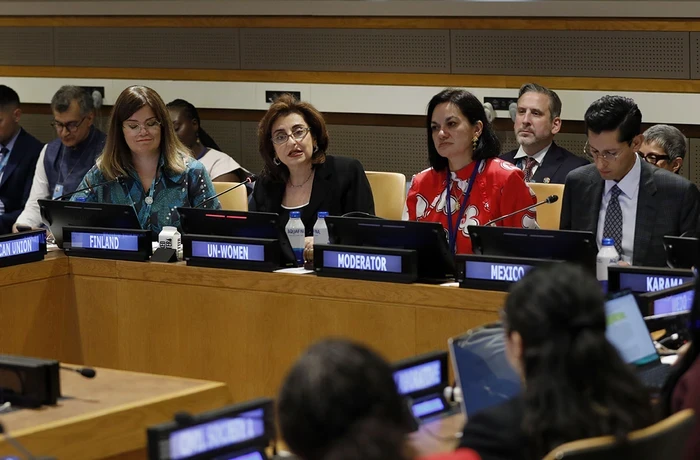
Remarks delivered by UN Under-Secretary-General and UN Women Executive Director Sima Bahous during the opening of the second regular session 2026 of the UN Women Executive Board, UN Headquarters, 9 September 2026.
[As delivered.]
I thank His Excellency Godfrey Kwoba, Ambassador at the Permanent Mission of Uganda, for presiding over our Executive Board this morning and for his stewardship and steadfast support.
My appreciation also to the Bureau members: Her Excellency Ambassador Suela Janina of Albania; Her Excellency Ambassador Sophie De Smedt of Belgium; Her Excellency Ambassador Aida Kasymalieva of Kyrgyzstan; and, serving informally for the Latin American and Caribbean Group, Her Excellency Alejandra Hernández of the Dominican Republic.
Allow me to begin on a positive note by celebrating progress made towards gender equality.
Last year brought renewed commitment to the Beijing Declaration and Platform for Action and gains for women and girls. Member States adopted or amended 69 laws advancing gender equality; 52 countries established formal care systems; and women peacebuilders participated in every UN-led peace process. This is only part of the picture.

The other part finds geopolitical tension, fiscal pressure, and a UN system under strain increasingly defining our operating environment. Conflict, economic insecurity, climate disruption, and the rollback of rights converge in the lives of women and girls, while women’s organizations confront surging needs with shrinking resources.
Humanitarian crises exact their highest price from women and girls, while their voices and leadership remain too often excluded from response and recovery. The devastating floods in China and Nepal and the Ebola outbreak remind us that crises take many forms but are never gender-neutral. UN Women continues to work with governments, humanitarian partners and women’s organizations to ensure responses reflect women’s needs, risks, and leadership, wherever needed.
Afghanistan remains a litmus test of our resolve, and we are failing, unfortunately. Five years on, women’s and girls’ ability to learn, work, and participate in public life has narrowed almost to disappearance. More than ever, we stand with Afghan women, and we support their organizations.
In Sudan, women and girls face drone attacks by day and the threat of sexual violence after dark. Yet women-led organizations supported by UN Women reach places others cannot, providing protection and essential services. We need to ensure they are supported.
In Haiti, women fleeing gang violence find that violence follows them into displacement. With UN Women’s support, the Government has opened the first state-supported safe houses for survivors, while women’s organizations continue providing lifesaving services.
In Gaza, we support local women organizations, provide lifesaving protection, cash assistance, and essential services to women and women-headed households – which now constitute one in four households.
We stay in Lebanon, in Myanmar, in Ukraine, and across the 103 countries where UN Women works, to serve and support women and girls. This is our mandate.
We began implementing our Strategic Plan in January of this year, putting the full strength of our triple mandate to work:
- To translate international norms into laws, policies, and budgets.
- To align the UN system around shared priorities and accountability, engaging 75 entities globally and 125 UN Country Teams to multiply impact.
- And to ensure women’s organizations shape action on the ground.
We are already seeing this approach deliver results.
In Albania, landmark reforms translated global standards into stronger protections for women from violence in public and political life, supported by UN Women’s policy expertise, UN coordination, and partnerships.
In Jordan, we are combining upstream policy advice with technical and normative support to accelerate implementation of the country’s Modernization Vision and to deliver measurable gains for women and girls. This is a model we will increasingly apply in middle-income countries and beyond.
In Papua New Guinea, we are supporting government and civil society to develop the country’s first National Action Plan on Women, Peace and Security, grounded in international commitments and informed by consultations with women in conflict-affected areas.
In Côte d’Ivoire, our policy expertise and convening power supported a legal reform doubling maternity leave for public servants to six months and increasing paternity leave from three to 30 days.
Our Safe Cities and Safe Public Spaces Initiative has reached 75 cities in 36 countries.
When Women Count began, only 26 per cent of the data needed to track SDG 5 were available. Today, it is 63 per cent.
In Afghanistan, we helped secure a twentyfold increase from the Women’s Peace and Humanitarian Fund – which we are proud to host as UN Women – for nearly 200 women-led organizations, reaching 350,000 women and girls last year.
Through the UN Trust Fund to End Violence against Women, we celebrate 30 years of investment in more than 620 women’s organizations across 140 countries and territories.
These results reflect a broader truth: civil society is indispensable to our mandate and to our impact. We work with women’s organizations and feminist movements to shape laws and policies, to expand their leadership, and channel resources to communities.
Young women are central to this ambition. Our Strategic Plan is clear: we will back their leadership, strengthen their organizations, and advance their rightful place in decision-making. This leadership must extend to the forces defining their future.
And technology and artificial intelligence are a defining frontier of gender equality – where progress can be accelerated or inequalities entrenched. Women and girls must actively shape it.
My participation in the Geneva High Level Digital Week this past July highlighted the urgency: only 24 of 138 national artificial intelligence strategies refer to gender. We will connect policy, evidence, and partnerships so digital governance delivers for women and girls.
We must also leverage technological and technology’s reach. In the second quarter this year, UN Women’s digital platforms gained 1.3 million followers, bringing our audience to more than 18 million – one of the largest followings in the United Nations system. This reach strengthens our advocacy and mobilizes new generations.
Together, these results show the power of our triple mandate. However, progress for women and girls is not UN Women’s mandate alone. It is an imperative of the UN Charter and the entire UN system. And it should concern us all that gender capacity and resourcing across the UN are weakening, while gender equality remains too rarely a stand-alone outcome in cooperation frameworks.
This is why UN80 is critical. As an entity born of UN reform, we know what institutional change makes possible. Reform must strengthen the gender equality architecture, not weaken or dilute it. UN80 must deliver a better United Nations for women and girls. We are determined to see it succeed.
Since our annual session, UN Women and UNFPA have completed the additional analysis you have requested on a potential merger and alternative options for greater alignment, impact, and efficiency. Informed by civil society perspectives, the analysis sets out the implications, opportunities, and risks of each pathway. As you determine the direction of this process, we remain available to inform your deliberations.
Meanwhile, we are deepening our collaboration with UNFPA and across the UN system. And we are engaging throughout UN80 to ensure the rights and needs of women and girls shape every aspect of the reform.
Flexible resources remain the lifeblood of our mandate, and we recognize your efforts to protect them. Current projections show UN Women’s regular resources declining by less than 1 per cent in 2026, with other resources declining by less than 5 per cent. I thank our development partners for their continued support amid difficult fiscal choices and urge you to sustain these investments.
Strong governance, transparency, and accountability are how we honour your trust. At this session, we look forward also to the Joint Working Group’s update on progress following the Joint Inspection Unit report on strengthening Executive Board governance and oversight. We stand ready to support the Board as it considers the way forward. This Board’s oversight sharpens our decisions, reinforces our accountability, and helps sustain the confidence upon which our work depends.
The months ahead will demand this same spirit of partnership. At the eighty-first session of the General Assembly [UNGA81], UN Women will drive efforts to place gender equality at its core.
UNGA81 convenes at a time of strain for multilateralism. Yet multilateral action remains indispensable to preventing conflict, to advancing human rights, and to addressing challenges no country can resolve alone. UNGA81 must put women’s equal leadership and rights at the heart of a reinvigorated multilateralism: more representative, accountable, and responsive – advanced through feminist foreign policies.
Our forthcoming Gender Snapshot, to be launched at UNGA81, underscores a fundamental truth: when women lead, societies do better. Yet today, six in every seven countries are led by men, and for the women who want to change that, eight in every ten women parliamentary candidates face intimidation or violence.
Through the UNGA Platform of Women Leaders, which we host annually with the President of the General Assembly, we will amplify women’s leadership.
We look forward to the Women, Peace and Security Open Debate on October 27 under the Presidency of Greece. The Secretary-General’s report will assess women’s declining participation in peace processes and remind us of what collective action can achieve.
At COP31, we will advance climate policies and financing that address impacts on women and girls and recognize their leadership.
At CSW71, we will work with Member States and civil society to build ambition to accelerate the Sustainable Development Goals and Agenda 2030.
UN Women continues to deliver for women and girls through our teams across the world, who drive impact with courage and determination amid extraordinary complexity. They are the face of UN Women, and I thank them all, with pride.
Before closing, allow me to extend special appreciation to our dear Executive Board Secretary, Mr. Jean-Luc Bories, at his final session after 15 years in this role. Jean-Luc, we are deeply grateful for your dedication and all you have given to this Board and to UN Women. You will be greatly missed. Thank you.
I am also pleased to welcome Mr. Ziad Sheikh, who succeeds Jean-Luc. Many of you know Ziad through Generation Equality and his leadership of our offices in Nepal and in Jordan. He has deep knowledge of UN Women, and I know this Board is in very good hands. Welcome, Ziad.
Our focus on the Strategic Plan is unswerving, our determination to make reform work for gender equality undimmed, and our commitment to partnership unwavering. The world does not wait for us. Nor do we wait for simpler times. You gave us a mandate that has never been more relevant; and every day, together, we make it real.
I want to thank you all very much. All the best.