
Universal menu

  • Global
  • Regions
    • Africa
    • Americas and the Caribbean
    • Arab States
    • Asia and the Pacific
    • Europe and Central Asia
  • Knowledge
  • Data
  • Training
  • Transparency
UN Women - For all women and girls

Main Navigation-HQ

  • Who we are
    • About us
      • About UN Women
      • Business model
      • Guiding documents
      • Worldwide presence
    • Leadership
      • Governance structure
      • Executive leadership
      • Executive Board
      • Accountability
    • Work with us
      • Employment
      • Procurement
      • Calls for proposals
      • Contact us
      • UN Women Strategic Plan 2026–2029
      • UN Women Strategic Plan 2026–2029 - social media image
        UN Women Strategic Plan 2026–2029
  • What we do
    • Focus areas
      • Ending violence against women
      • Peace and security
      • Humanitarian action
      • Leadership and governance
      • Economic empowerment
      • Innovation and technology
      • Women with disabilities
      • Youth
      • HIV and AIDS
    • How we work
      • 2030 Agenda for Sustainable Development
      • Commission on the Status of Women
      • Gender parity in the UN system
      • Intergovernmental support
      • Partnerships
      • Research and data
      • Training Centre
      • Trust funds
      • UN system coordination
      • Gender Equality Accelerators
      • Gender Equality Accelerators artwork
        Gender Equality Accelerators
  • News and stories
    • Latest
      • News
      • Articles and explainers
      • In focus
    • Media center
      • Press materials
      • Media contacts
      • Explainer: Why are women so exhausted? Care work and the mental load
      • Two adults stand at a table changing diapers on baby dolls, with laundry hanging on a clothesline behind them in a home setting.
        Explainer: Why are women so exhausted? Care work and the mental load
      • Press release: Aid cuts dismantle women’s organizations working in humanitarian crises
      • A young Ugandan woman sits with another local woman to talk
        Press release: Aid cuts dismantle women’s organizations working in humanitarian crises
  • Digital library
    • Resources
      • Publications
      • Annual reports
      • Gender snapshot
      • Progress of the world’s women
      • World survey on the role of women in development
    • GenderTerm
      • GenderTerm
      • Reprint permissions
      • UN Women Highlights 2025–2026
      • A smiling woman.
        UN Women Highlights 2025–2026
      • Gender snapshot 2026
      • A diverse group of people represented as simplified silhouettes, arranged against a dark blue background.
        Gender snapshot 2026
  • Get involved
    • How to get involved
      • For ALL Women and Girls
      • International Women's Day
      • 16 Days of Activism to End Violence against Women and Girls
      • UNiTE! Campaign to End Violence against Women
      • Generation Equality
      • He for She
Ask AI
https://84e5cfacd5c7e99f9825edf344450c.1b.environment.api.powerplatform.com/powervirtualagents/botsbyschema/crad4_websiteQA/directline/token?api-version=2022-03-01-preview
1
-
Ask your question here
AI website assistant

Hello, how can I assist you?

AI chatbot responses may be incorrect. Always verify important information.

Donate button menu

Donate

Breadcrumb

  1. Home
  2. News and stories
  3. Statement

Website survey

We want to know how we can improve your experience on this website. Completing this survey takes less than 5 minutes.

TAKE THE SURVEY
Statement

Statement: Crises drive an increase in human trafficking – Here’s how we stop it

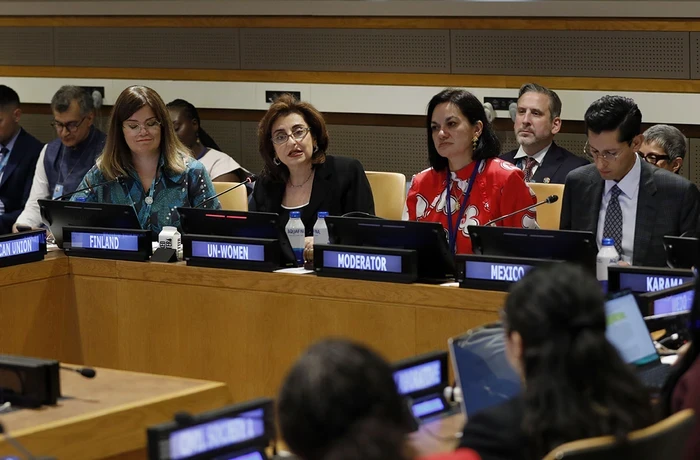
Statement by Ms. Sima Bahous, UN Women Executive Director, for the World Day against Trafficking in Persons, 30 July 2022

29 July 2022
UN Women Executive Director Sima Bahous
  • Share to Facebook
  • Share to Twitter
  • Share to LinkedIn
  • Share to E-mail

Approximately a quarter of the world’s population, two billion people, are currently living in conflict areas, in highly unsettled conditions that create vulnerabilities and risks of trafficking for women and girls. Recent research has revealed that human trafficking was present in 90 per cent of the 171 wars and conflicts that took place between 1989 and 2016. Additional crises such as the COVID-19 pandemic and climate change further exacerbate these risks, together with poverty and economic insecurity, displacement and lack of access to safe migration pathways, and exposure to multiple forms of gender-based violence.

Women and girls represent 65 per cent of all trafficking victims globally. More than 90 per cent of detected female victims are trafficked for the purpose of sexual exploitation. Within months of the invasion of the Ukraine by the Russian Federation, global searches for Ukrainian women escort services had increased by 300 per cent. This demand incentivizes traffickers to recruit and exploit victims, increasingly using online platforms and tools. The shift in women’s and girls’ lives from the start of COVID-19 to go online for work, education, and social activities, has opened fresh opportunities for recruitment, control, and exploitation. But the increased use of technology has also created positive opportunities to investigate practices like deceptive job offers, to enhance prosecution with digital evidence, and to provide support services to survivors.

Women survivors provide vital insights into the design of preventive measures. Advice from groups such as the International Survivors of Trafficking Advisory Council (ISTAC) inform all our reporting on this vital issue, as well as the work of the Interagency Working Group Against Trafficking. Shandra Woworuntu, the Chair of ISTAC, has underlined their strategic role: “Survivor leaders provide input on trafficking patterns used by traffickers, and increase the understanding and context of trafficking developments, while addressing the needs of survivors.”

Currently, awareness-raising campaigns are the primary focus area of work to prevent trafficking. With a clear understanding of the driving factors, we can pay the necessary attention to the gendered dimensions of vulnerability, including women’s economic inequality, challenging harmful masculinities, and changing norms that justify exploitation and abuse of women and girls.

Sustainable Development Goal 5 on gender equality recognizes trafficking in women and girls as a form of violence against women that must be ended. There is much more that we can do to ensure that humanitarian responses adequately protect women’s rights and include anti-trafficking measures, crucially ensuring that those measures are led and informed by women survivors.

Immediate, practical measures are available to achieve the necessary change. Investing in education and community-based programming can address the demand that fosters sexual exploitation. The provision of safe and orderly migration options can remove a core component of a trafficker’s toolkit—the promise of migration. The Spotlight Initiative has been supporting safe migration and protection from different forms of violence for migrant women workers, including their use of mobile phones to enhance access to information on safe migration and services.

In view of the increasing role of technology in facilitating trafficking, partnerships with technology and social media companies can help governments to strengthen their detection and prevention efforts. They can also increase access to help and support for survivors. These needs include access to long-term, comprehensive reintegration support, including economic empowerment and psychological services.

Crises around the world are more than likely to increase in frequency and intensity in the years to come. We have tactics to prevent that rise from translating into increased exploitation. By implementing them, working in a concerted way internationally, together with survivors on prevention, detection, and response efforts, we can stop trafficking of women and girls around the world for good.
Topics

  • Ending violence against women and girls
  • Trafficking/sexual exploitation
  • Humanitarian action
  • Crisis response and recovery
  • Peace and security
  • UN Women administration
  • Executive Director

Related content

Image
UNWomen_Placeholder
Press release

Middle East escalation could leave 11.7 million more women and girls facing food insecurity by end-2026

2 October 2026
Middle East escalation could leave 11.7 million more women and girls facing food insecurity by end-2026
Image
UNWomen_Placeholder
Press briefing

Middle East escalation threatens food security for an additional 11.7 million women and girls by the end of 2026

2 October 2026
Middle East escalation threatens food security for an additional 11.7 million women and girls by the end of 2026
Image
UN Women Executive Director Sima Bahous speaks at the High-Level Dialogue on Reinvigorating Feminist Multilateralism held at the UN Headquarters during the High-Level week of the 81st session of the UN General Assembly on 25 September 2026.  Photo: UN Women/Ryan Brown
Speech

Speech: Multilateralism will only remain fit for purpose if it shares power, centres women’s leadership, and delivers for the people it serves

25 September 2026
Speech: Multilateralism will only remain fit for purpose if it shares power, centres women’s leadership, and delivers for the people it serves

Footer menu-HQ

  • News and stories
  • Resources
  • What we do
  • How we work
  • Where we are
  • Partnerships
  • Employment
  • Procurement
  • Contact us
  • Executive Board
  • Commission on the Status of Women

Donate button menu [Footer tablet]

  • Donate

Donate button menu [Footer]

  • Donate

Social media menu

  • Facebook
  • Twitter
  • LinkedIn
  • Flickr
  • YouTube
  • Instagram
UN Women - For all women and girls

Footer bottom [Menu]

  • Copyright
  • Information security
  • Privacy notice
  • Report wrongdoing
  • Terms of use
Share this page
  • Share to Facebook
  • Share to Twitter
  • Share to LinkedIn
  • Share to E-mail

Or copy link