
Universal menu

  • Global
  • Regions
    • Africa
    • Americas and the Caribbean
    • Arab States
    • Asia and the Pacific
    • Europe and Central Asia
  • Knowledge
  • Data
  • Training
  • Transparency
UN Women - For all women and girls

Main Navigation-HQ

  • Who we are
    • About us
      • About UN Women
      • Business model
      • Guiding documents
      • Worldwide presence
    • Leadership
      • Governance structure
      • Executive leadership
      • Executive Board
      • Accountability
    • Work with us
      • Employment
      • Procurement
      • Calls for proposals
      • Contact us
      • UN Women Strategic Plan 2026–2029
      • UN Women Strategic Plan 2026–2029 - social media image
        UN Women Strategic Plan 2026–2029
  • What we do
    • Focus areas
      • Ending violence against women
      • Peace and security
      • Humanitarian action
      • Leadership and governance
      • Economic empowerment
      • Innovation and technology
      • Women with disabilities
      • Youth
      • HIV and AIDS
    • How we work
      • 2030 Agenda for Sustainable Development
      • Commission on the Status of Women
      • Gender parity in the UN system
      • Intergovernmental support
      • Partnerships
      • Research and data
      • Training Centre
      • Trust funds
      • UN system coordination
      • Gender Equality Accelerators
      • Gender Equality Accelerators artwork
        Gender Equality Accelerators
  • News and stories
    • Latest
      • News
      • Articles and explainers
      • In focus
    • Media center
      • Press materials
      • Media contacts
      • Explainer: Why are women so exhausted? Care work and the mental load
      • Two adults stand at a table changing diapers on baby dolls, with laundry hanging on a clothesline behind them in a home setting.
        Explainer: Why are women so exhausted? Care work and the mental load
      • Press release: Aid cuts dismantle women’s organizations working in humanitarian crises
      • A young Ugandan woman sits with another local woman to talk
        Press release: Aid cuts dismantle women’s organizations working in humanitarian crises
  • Digital library
    • Resources
      • Publications
      • Annual reports
      • Gender snapshot
      • Progress of the world’s women
      • World survey on the role of women in development
    • GenderTerm
      • GenderTerm
      • Reprint permissions
      • UN Women Highlights 2025–2026
      • A smiling woman.
        UN Women Highlights 2025–2026
      • Gender snapshot 2026
      • A diverse group of people represented as simplified silhouettes, arranged against a dark blue background.
        Gender snapshot 2026
  • Get involved
    • How to get involved
      • For ALL Women and Girls
      • International Women's Day
      • 16 Days of Activism to End Violence against Women and Girls
      • UNiTE! Campaign to End Violence against Women
      • Generation Equality
      • He for She
Ask AI
https://84e5cfacd5c7e99f9825edf344450c.1b.environment.api.powerplatform.com/powervirtualagents/botsbyschema/crad4_websiteQA/directline/token?api-version=2022-03-01-preview
1
-
Ask your question here
AI website assistant

Hello, how can I assist you?

AI chatbot responses may be incorrect. Always verify important information.

Donate button menu

Donate

Breadcrumb

  1. Home
  2. News and stories
  3. Feature story

Website survey

We want to know how we can improve your experience on this website. Completing this survey takes less than 5 minutes.

TAKE THE SURVEY
Feature

Serving through crisis: UN Women’s humanitarian workers on what keeps them going

For World Humanitarian Day, UN Women staff in the Central African Republic, Sudan, Lebanon, Myanmar, Afghanistan, and Ukraine share what it means to serve while surviving crisis.

17 August 2026
  • Share to Facebook
  • Share to Twitter
  • Share to LinkedIn
  • Share to E-mail
Nour Abdul Reda, 28, a Programme Associate with UN Women Lebanon’s Women’s Economic Empowerment programme. Photo: UN Women/Georges Roukoz

Basic Hero Banner

Every year on 19 August, World Humanitarian Day honours the people who deliver aid in the world’s most dangerous and difficult places. 

For UN Women, that means staff working alongside women and girls affected by conflict, displacement, and disaster – helping them survive crisis and then rebuild their lives, livelihoods, and their communities. Change, in this work, rarely looks like a single dramatic breakthrough. It happens one woman at a time – through the support she receives, the choices she is able to make again, and the ripple effect that reaches her children, her family, and the women around her.

Is what we are doing making a difference – UN Women humanitarian workers in Sudan and Lebanon

“Is what we are doing really making a difference in women’s lives?”

This is a question UN Women’s Safia Elamin regularly asks herself. Elamin works on humanitarian response, supporting survivors of violence in her home country Sudan, which erupted into civil war in April 2023. 

It is a simple question, but for humanitarian workers operating in some of the world’s most difficult emergencies, the answer is not so straightforward.

UN Women staff are working with communities affected by conflict, displacement, disasters, and insecurity. They serve women who have survived violence, lost their homes, livelihoods, and loved ones. They work with limited resources, make decisions under pressure and, sometimes, experience the same atrocities and crises as the people they are there to support.

Image
A young woman with a UN Women vest helps local women bake bread with za'atar
Nour Abdul Reda meets with women during a field visit to a UN Women-supported, women-led bakery at the Montana Shelter in Nabatieh, Lebanon. Photo: UN Women/Georges Roukoz

In Lebanon, UN Women’s Nour Abdul Reda describes what she calls the “numbers trap” – while the number of people in need and served is critical data for humanitarian action, she has to remind herself that “these are not numbers; these are women, these are their stories, this is what resilience looks like.”

Reda knows this distinction personally. In early March 2026, Reda was woken in the middle of the night by the sound of bombing nearby. She packed a small bag and carried her one-month-old nephew to safety as her sister gathered her other children. Hours later, she was at work, helping coordinate the humanitarian response for people who, like her, had been forced to flee their homes.

“I cannot remember everything that was said in those meetings”, says Reda, “but I will never forget carrying my one-month-old nephew to safety a few hours before discussing how to support thousands of families trying to do the very same thing.”

Image
Women sit together on the ground as one woman interviews people about their experiences after a recent earthquake
Rebecca, 33, Programme Assistant with UN Women Myanmar, speaks with earthquake-affected women while conducting a Rapid Gender Analysis in Mandalay in April 2025. The magnitude 7.7 earthquake struck central Myanmar on 28 March 2025, causing widespread devastation. Although her family home in Mandalay was partially damaged, Rebecca supported field assessments to ensure that women’s and girls’ experiences and urgent needs informed the humanitarian response. Photo: UN Women

Responding to humanitarian crisis while living through it in Myanmar

“Humanitarian work is about standing with communities in their most difficult moments – even when you are experiencing the same crisis yourself”, explains Rebecca, who works with UN Women in Myanmar and found herself simultaneously responding to a crisis while experiencing it herself.

After a catastrophic earthquake struck Mandalay – Rebecca’s hometown – in March 2025, she was deployed to respond. Her home was damaged and her family was affected. At the same time, Rebecca was responsible for supporting the emergency response.

Day in and day out, she went from coordination meetings to affected communities, listening to the experiences of women and girls and gathering information about their needs. At night, Rebecca put together what she had seen and heard so that humanitarian actors could respond more effectively.

Rebecca describes the toll it took on her: “By the end of each day, my whole body was exhausted, but despite how tired I was, I often couldn’t sleep. The stories I had heard and the devastation I had witnessed stayed with me. Knowing that the information we gathered would help humanitarian actors better understand the needs of affected communities gave me the strength to keep going.”

“It was one of the most challenging experiences of my life”, says Rebecca, “but it was also one of the most meaningful.”

For UN Women staff working on humanitarian response, one of the hardest realities is seeing how much people need – and knowing that there are not enough resources to meet those needs.

Beyond the breaking point: The continuing impact of funding cuts on women’s organizations in humanitarian settings

Publication cover
Read the report
Download

The widening gap between need and humanitarian funding – A reality check from Afghanistan

In Afghanistan, a constant stream of emergencies from flash floods to earthquakes to cross-border hostilities, in a context where women’s rights are increasingly restricted, have created a deeply challenging operating environment.

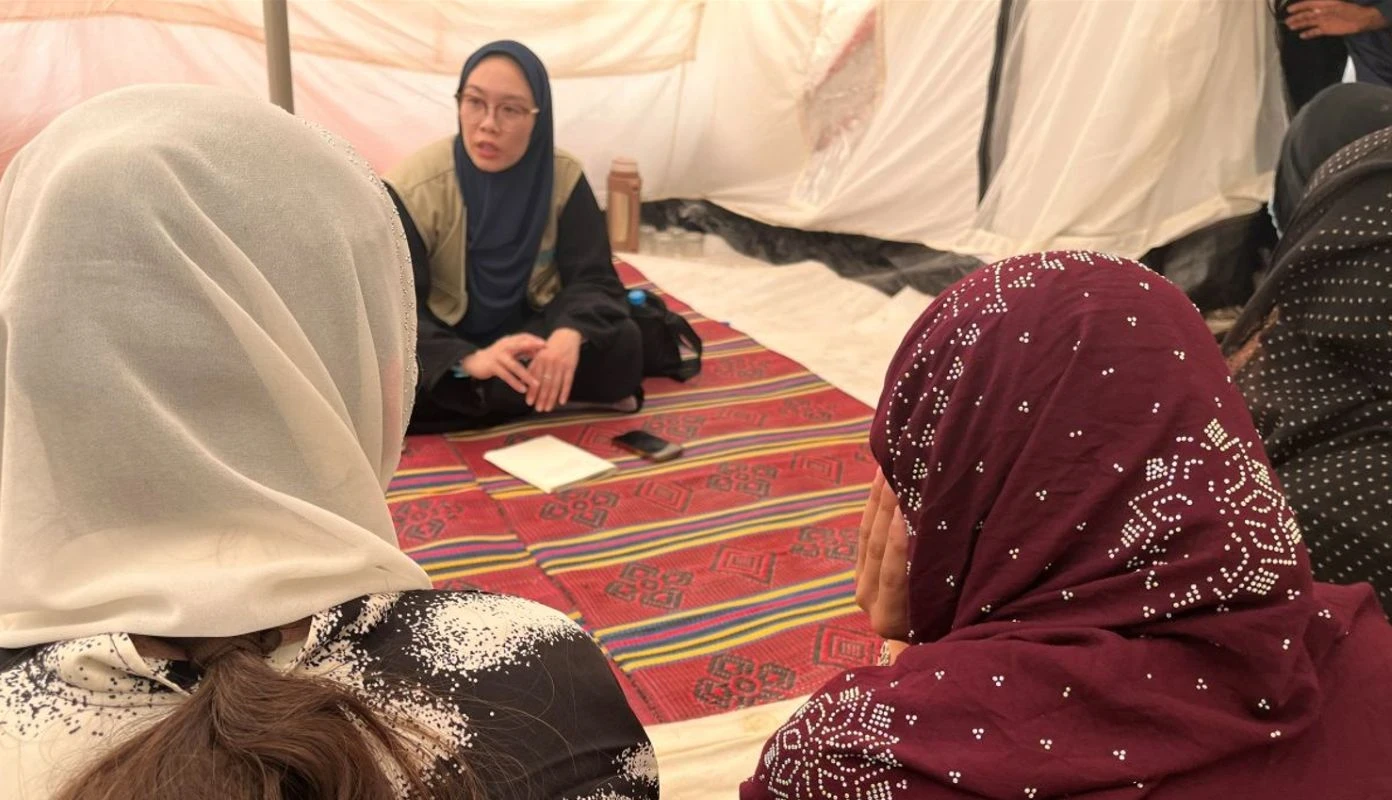
Following a magnitude 6.0 earthquake in Kunar province in September 2025, Araya Arayawuth, Head of Jalalabad Sub-Office for UN Women Afghanistan, and her colleagues travelled into a remote mountainous valley on foot to meet affected communities after they were forced to abandon their cars.
  • Image
    A young woman with glasses speaks with women in a remote Afghan village
    Araya Arayawuth, Head of UN Women Afghanistan’s Sub-Office in Jalalabad, travelled by car and on foot through areas blocked by debris to meet women and girls affected by the devastating earthquake that struck eastern Afghanistan in August 2025. With other UN Women colleagues and women humanitarians from local partner organizations, she gathered critical information on how women and girls had been affected and their most urgent needs, to help inform the broader response by the UN and humanitarian partners. Photo: UN Women
  • Image
    A young woman poses in front of a scenic river in Afghanistan
    Araya Arayawuth, Head of UN Women Afghanistan’s Sub-Office in Jalalabad, travelled by car and on foot through areas blocked by debris to meet women and girls affected by the devastating earthquake that struck eastern Afghanistan in August 2025. With other UN Women colleagues and women humanitarians from local partner organizations, she gathered critical information on how women and girls had been affected and their most urgent needs, to help inform the broader response by the UN and humanitarian partners. Photo: UN Women
  • Image
    UN Women staff speak with women and children who have been impacted by a recent earthquake
    Araya Arayawuth, Head of UN Women Afghanistan’s Sub-Office in Jalalabad, travelled by car and on foot through areas blocked by debris to meet women and girls affected by the devastating earthquake that struck eastern Afghanistan in August 2025. With other UN Women colleagues and women humanitarians from local partner organizations, she gathered critical information on how women and girls had been affected and their most urgent needs, to help inform the broader response by the UN and humanitarian partners. Photo: UN Women
    • Image
      A young woman with glasses speaks with women in a remote Afghan village
      Araya Arayawuth, Head of UN Women Afghanistan’s Sub-Office in Jalalabad, travelled by car and on foot through areas blocked by debris to meet women and girls affected by the devastating earthquake that struck eastern Afghanistan in August 2025. With other UN Women colleagues and women humanitarians from local partner organizations, she gathered critical information on how women and girls had been affected and their most urgent needs, to help inform the broader response by the UN and humanitarian partners. Photo: UN Women
    • Image
      A young woman poses in front of a scenic river in Afghanistan
      Araya Arayawuth, Head of UN Women Afghanistan’s Sub-Office in Jalalabad, travelled by car and on foot through areas blocked by debris to meet women and girls affected by the devastating earthquake that struck eastern Afghanistan in August 2025. With other UN Women colleagues and women humanitarians from local partner organizations, she gathered critical information on how women and girls had been affected and their most urgent needs, to help inform the broader response by the UN and humanitarian partners. Photo: UN Women
    • Image
      UN Women staff speak with women and children who have been impacted by a recent earthquake
      Araya Arayawuth, Head of UN Women Afghanistan’s Sub-Office in Jalalabad, travelled by car and on foot through areas blocked by debris to meet women and girls affected by the devastating earthquake that struck eastern Afghanistan in August 2025. With other UN Women colleagues and women humanitarians from local partner organizations, she gathered critical information on how women and girls had been affected and their most urgent needs, to help inform the broader response by the UN and humanitarian partners. Photo: UN Women

    “The valley is remote and mountainous”, describes Arayawuth. “We had to navigate a tight, unpaved road. After a while we were no longer able to move forward by car. The mission team left our convoy to trek on foot to meet with affected families. We crossed rivers, hiked through cornfields, jumped over rubble, all while facing aftershocks every 20 minutes that echoed like thunder. After a few hours, we finally reached a community of women taking shelter under a makeshift tent who had lost everything and had been in search for assistance for two days. This broke my heart.”

    “The hardest part [for me…] is the emotional pain”, says Arayawuth, “especially when meeting affected women and girls who are suffering, and knowing that we can only do so much to help with limited resources.” But what Arayawuth sees in the women and girls she serves is “resilience, strength, and optimism”, which inspires her to do better and do more.

    What resilience really looks like

    In Sudan, Elamin’s fight for gender equality is driven by the injustice she has witnessed around her. She remembers a woman who worked alongside her husband on a farm. When the harvest came, her husband sold the produce and controlled the income. For Elamin, that story showed the tangible, ground reality of gender inequality: She had helped produce the harvest but had no say over what happened to the money made from it.

    Elamin explains how the war has deepened existing inequalities while simultaneously shifted responsibilities – with women carrying an even greater share of work than before. “Many women suddenly became responsible for entire households. Their usual family and social support were no longer there, but their children still needed food, education, and care.”

    Image
    Men and women gather in a circle to talk during a field session
    Ulrich Martial Bienvenu Sandy, UN Women Recovery Programme Officer in the Central African Republic, participates in a field working session in Mobaye, Basse-Kotto Prefecture, with the Association of Women Lawyers of the Central African Republic (AFJC) and members of the Association of Volunteers of Mobaye. The session was part of a joint UN Women and Ministry for the Promotion of Gender monitoring mission for the SEDOUTI project, implemented with UNDP and IOM with financial support from the Peacebuilding Fund (PBF), in August 2026. Photo: UN Women CAR/Edson De Blaise Langate Otto Kpindet
    Ulrich Martial Bienvenu Sandy, UN Women Recovery Programme Officer in the Central African Republic, participates in a field working session in Mobaye, Basse-Kotto Prefecture, with the Association of Women Lawyers of the Central African Republic (AFJC) and members of the Association of Volunteers of Mobaye. The session was part of a joint UN Women and Ministry for the Promotion of Gender monitoring mission for the SEDOUTI project, implemented with UNDP and IOM with financial support from the Peacebuilding Fund (PBF), in August 2026. Photo: UN Women CAR/Edson De Blaise Langate Otto Kpindet

    In the Central African Republic, UN Women’s Ulrich Martial Bienvenu Sandy describes the women he serves as “farmers, entrepreneurs, mothers, mediators, peacemakers, human rights defenders, leaders, and innovators.” Sandy’s commitment to women’s empowerment is grounded in the memory of his late mother, who sacrificed her own career aspirations and personal needs for her family.

    “Many women lead, produce, mediate, and rebuild, but institutions and systems do not always recognize their contribution. This gap between women’s true contribution and their limited recognition is one of the most challenging realities of this work”, he says.

    Sandy’s personal experience of loss did not end there. A few months ago, he lost his wife, who died while giving birth. The experience, he says, made him understand more deeply the realities faced by the people humanitarian workers are trying to support. “For me, every empowered woman is a tribute to the memory of my mother and, today, my late wife”, he says. “Every life transformed reminds me that their sacrifices were not in vain.”

    Image
    Two women wearing protective demining vests speak to one another. They are standing in a forest.
    Olha Lishyk (right), UN Women Ukraine Programme Analyst, works to expand women’s participation in humanitarian mine action through the “She Demines” programme. Photo: UN Women/Andrii Bren
    Olha Lishyk (right), UN Women Ukraine Programme Analyst, works to expand women’s participation in humanitarian mine action through the “She Demines” programme. Photo: UN Women/Andrii Bren

    From survival to leadership in Ukraine

    In Ukraine, women are central to the country’s recovery – and coping with the full-scale war. Women are entering professions once considered traditionally male dominated, including humanitarian mine action, working as deminers, team leaders, and technical experts.

    Through the UN Women “She Demines” programme, women are gaining skills and new career opportunities while helping communities become safer. UN Women’s Olha Lishyk, a Programme Analyst on Gender in Humanitarian Mine Action who leads this work, explains how expanding women’s participation is not only about equality, but making humanitarian mine action more effective and ensuring that the skills of everyone are recognized.

    Lishyk lost her home following Russia’s full-scale invasion in 2022. “My work is more than just a profession to me”, says Lishyk. “It is an opportunity to help people return to safety and rebuild their lives.”

    One woman – many impacts. UN Women stands with all women and girls, everywhere, every day

    From Ukraine to Sudan, Central African Republic, Lebanon, Afghanistan, Myanmar, and everywhere else, UN Women’s humanitarian workers share a similar sentiment about the impact of their work.

    “You may think you are supporting one woman, but the impact does not necessarily stop with her. It can reach her children, her family, and other women around her. Those are the moments that make the difficult days worthwhile”, says Elamin. 

    Change can happen – but it happens beyond the numbers, targets, and immediate results that humanitarian systems measure. It happens through each and every woman and girl that UN Women supports in humanitarian crisis – as they flee, rebuild, recover, negotiate peace, seek power, support their families and communities, and stand tall with dignity.
    Topics

    • Humanitarian action
    • Crisis response and recovery
    • Disaster risk reduction
    • Peace and security
    • Asia and the Pacific
    • Africa
    • Arab States/North Africa
    • Europe and Central Asia
    • Afghanistan
    • Central African Republic
    • Lebanon
    • Myanmar
    • Sudan
    • Ukraine

    Related content

    Image
    UNWomen_Placeholder
    Press briefing

    Middle East escalation threatens food security for an additional 11.7 million women and girls by the end of 2026

    2 October 2026
    Middle East escalation threatens food security for an additional 11.7 million women and girls by the end of 2026
    Image
    UNWomen_Placeholder
    Press release

    Middle East escalation could leave 11.7 million more women and girls facing food insecurity by end-2026

    2 October 2026
    Middle East escalation could leave 11.7 million more women and girls facing food insecurity by end-2026
    Image
    Five women chefs stand together, arms folded, and pose for a photo
    Feature

    One month after the Nepal floods, women are running community kitchens, feeding their communities, and rebuilding their lives

    25 September 2026
    One month after the Nepal floods, women are running community kitchens, feeding their communities, and rebuilding their lives

    Footer menu-HQ

    • News and stories
    • Resources
    • What we do
    • How we work
    • Where we are
    • Partnerships
    • Employment
    • Procurement
    • Contact us
    • Executive Board
    • Commission on the Status of Women

    Donate button menu [Footer tablet]

    • Donate

    Donate button menu [Footer]

    • Donate

    Social media menu

    • Facebook
    • Twitter
    • LinkedIn
    • Flickr
    • YouTube
    • Instagram
    UN Women - For all women and girls

    Footer bottom [Menu]

    • Copyright
    • Information security
    • Privacy notice
    • Report wrongdoing
    • Terms of use
    Share this page
    • Share to Facebook
    • Share to Twitter
    • Share to LinkedIn
    • Share to E-mail

    Or copy link