Universal menu

  • Global
  • Regions
    • Africa
    • Americas and the Caribbean
    • Arab States
    • Asia and the Pacific
    • Europe and Central Asia
  • Knowledge
  • Data
  • Training
  • Transparency
UN Women - For all women and girls

Main Navigation-HQ

  • Who we are
    • About us
      • About UN Women
      • Business model
      • Guiding documents
      • Worldwide presence
    • Leadership
      • Governance structure
      • Executive leadership
      • Executive Board
      • Accountability
    • Work with us
      • Employment
      • Procurement
      • Calls for proposals
      • Contact us
      • UN Women Strategic Plan 2026–2029
      • UN Women Strategic Plan 2026–2029 - social media image
        UN Women Strategic Plan 2026–2029
  • What we do
    • Focus areas
      • Ending violence against women
      • Peace and security
      • Humanitarian action
      • Leadership and governance
      • Economic empowerment
      • Innovation and technology
      • Women with disabilities
      • Youth
      • HIV and AIDS
    • How we work
      • 2030 Agenda for Sustainable Development
      • Commission on the Status of Women
      • Gender parity in the UN system
      • Intergovernmental support
      • Partnerships
      • Research and data
      • Training Centre
      • Trust funds
      • UN system coordination
      • Gender Equality Accelerators
      • Gender Equality Accelerators artwork
        Gender Equality Accelerators
  • News and stories
    • Latest
      • News
      • Articles and explainers
      • In focus
    • Media center
      • Press materials
      • Media contacts
      • Explainer: Why are women so exhausted? Care work and the mental load
      • Two adults stand at a table changing diapers on baby dolls, with laundry hanging on a clothesline behind them in a home setting.
        Explainer: Why are women so exhausted? Care work and the mental load
      • Press release: Aid cuts dismantle women’s organizations working in humanitarian crises
      • A young Ugandan woman sits with another local woman to talk
        Press release: Aid cuts dismantle women’s organizations working in humanitarian crises
  • Digital library
    • Resources
      • Publications
      • Annual reports
      • Gender snapshot
      • Progress of the world’s women
      • World survey on the role of women in development
    • GenderTerm
      • GenderTerm
      • Reprint permissions
      • UN Women Highlights 2025–2026
      • A smiling woman.
        UN Women Highlights 2025–2026
      • Gender snapshot 2026
      • A diverse group of people represented as simplified silhouettes, arranged against a dark blue background.
        Gender snapshot 2026
  • Get involved
    • How to get involved
      • For ALL Women and Girls
      • International Women's Day
      • 16 Days of Activism to End Violence against Women and Girls
      • UNiTE! Campaign to End Violence against Women
      • Generation Equality
      • He for She
Ask AI
https://84e5cfacd5c7e99f9825edf344450c.1b.environment.api.powerplatform.com/powervirtualagents/botsbyschema/crad4_websiteQA/directline/token?api-version=2022-03-01-preview
1
-
Ask your question here
AI website assistant

Hello, how can I assist you?

AI chatbot responses may be incorrect. Always verify important information.

Donate button menu

Donate

Breadcrumb

  1. Home
  2. News and stories
  3. Press briefing

Website survey

We want to know how we can improve your experience on this website. Completing this survey takes less than 5 minutes.

TAKE THE SURVEY
Press briefing

Women’s care work fuels an unaccounted death toll in the fastest-growing Ebola outbreak on record

Remarks by Setcheme Mongbo, UN Women Representative in the Democratic Republic of the Congo – to whom quoted text may be attributed – at the press briefing at the Palais des Nations in Geneva

18 September 2026
  • Share to Facebook
  • Share to Twitter
  • Share to LinkedIn
  • Share to E-mail

[As prepared]

Kinshasa, Geneva, 18 September 2026 – “I have just returned from Bunia, the epicentre of the Democratic Republic of the Congo’s 17th Ebola outbreak – and what is now the fastest-growing outbreak on record.

What I saw there was a bleak picture of what this outbreak does to women and girls.

Women are on the front line – in health centres, in homes and in their communities. And they are paying the price, sometimes with their lives.

Women and girls caring for the sick – young and old – as health workers in health centres, and as carers at home. Women and girls washing and burying the dead. Women and girls collecting water and food.

When it comes to Ebola, care is a chain of transmission. Because Ebola transmission mirrors the distribution of these care responsibilities, women and girls account for most cases.

Latest available official data indicate that more than 54 per cent of confirmed Ebola cases in the DRC are among women. Among adolescents aged between 10 and17 years, girls account for 61 per cent of cases. 

But there are also likely to be deaths occurring in communities that do not appear in official Ebola figures. 

In Bunia, I heard accounts of women becoming sick – and dying – at home.

Community members told me that four women had died at home in a single day. We were unable to verify whether they had subsequently been captured in official surveillance data, but the reports are nevertheless concerning. 

When people become sick and die outside the formal health system, there is a risk that their deaths and the circumstances surrounding them will not be adequately captured in the official response.

Women told me why.

Because they put the health of their children and family members before their own. They care for sick relatives at home without protective equipment, and they delay seeking care when they themselves become ill.

One woman told me that entering an Ebola treatment centre felt like a one-way journey – separated from her children, and unsure when or whether she will return home.

According to recent data, two-thirds of deaths recorded in a single 24-hour period occurred in communities, rather than in treatment centres.

For women, the fear of going to a facility is made worse by concerns about stigma, harassment, separation from their children, and, in some cases, their safety.

For some, getting to a facility is almost impossible. Decades of conflict, insecurity, and road conditions mean that regular transport in many communities is unavailable.

The health systems are overwhelmed, and women are losing access to maternity care, reproductive health services, and other essential care, putting them at additional risk.

Poverty is also playing its part. Women make up around three-quarters of traders in the affected areas. Restrictions on movement and border closures have stripped many women of their income. Women traders told us that their daily income has reduced by $20-$30, leaving them unable to feed their families.

Eight in ten women’s organizations that UN Women surveyed told us that the border closures are increasing poverty among women.

Women-led organizations are critical in the Ebola response. They have spent years building trust. Their communities know them, and they can reach women in places where others cannot. This trust matters. When women are afraid of treatment centres, or distrust the response, they are more likely to turn first to people that they already know and trust. Women-led organizations are those people.

They are also reaching women who may never appear in the official response system – including women caring for sick relatives at home. They are already helping to identify risks, share information, distribute water and sanitation supplies, and connect communities with services. But they are doing this with minimal resources.

Despite doing incredible work in extremely challenging conditions and being on the front lines of the response and the most trusted sources of support and information, women’s organizations are desperately underfunded. UN Women data found that the vast majority – 86 per cent – have not received funding specifically for the Ebola response.

UN Women is supporting the Ebola response in the DRC by working to ensure that women and girls’ specific needs and risks are addressed. This includes working with women-led organizations and communities to improve Ebola awareness and prevention, increase women’s participation in the response, and prevent gender-based violence.”

Learn more

3
4
Image
A female healthcare professional speaks with a patient seated across a desk in a clinic.
Explainer

Six uncomfortable truths about women’s health

6 April 2026
Image
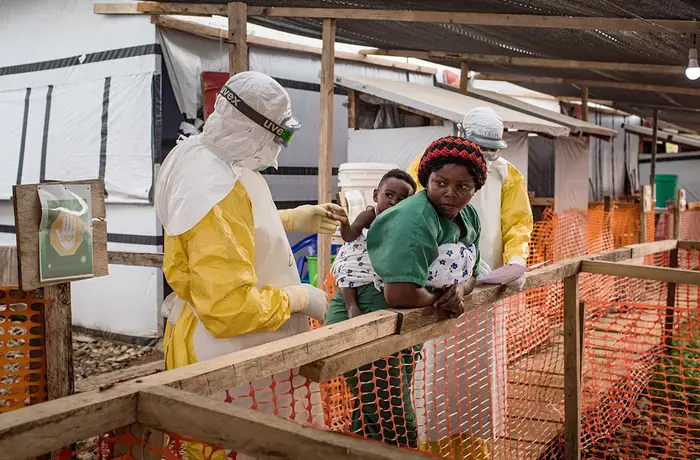
Health worker wearing protective equipment checks a child being carried on a caregiver’s back at an Ebola treatment centre.
FAQs

What happens to women during an Ebola outbreak? Pregnancy, caregiving, violence, and survival — explained

23 June 2026
Image placeholder with UN Women logo (English) - 3:2 aspect ratio
Statement

For 50 years, women have been overrepresented in Ebola deaths – UN Women fears the current outbreak will follow the same pattern

22 May 2026
Image placeholder with UN Women logo (English) - 3:2 aspect ratio
Statement

UN Women statement: Women and girls account for the majority of laboratory-confirmed Ebola cases in the Democratic Republic of the Congo and Uganda

12 June 2026

Topics

  • Health
  • Humanitarian action
  • Conflict, war
  • Africa
  • Congo, Democratic Republic of the

Related content

Image
UNWomen_Placeholder
Press release

Middle East escalation could leave 11.7 million more women and girls facing food insecurity by end-2026

2 October 2026
Middle East escalation could leave 11.7 million more women and girls facing food insecurity by end-2026
Image
UNWomen_Placeholder
Press briefing

Middle East escalation threatens food security for an additional 11.7 million women and girls by the end of 2026

2 October 2026
Middle East escalation threatens food security for an additional 11.7 million women and girls by the end of 2026
Image
Five women chefs stand together, arms folded, and pose for a photo
Feature

One month after the Nepal floods, women are running community kitchens, feeding their communities, and rebuilding their lives

25 September 2026
One month after the Nepal floods, women are running community kitchens, feeding their communities, and rebuilding their lives

Footer menu-HQ

  • News and stories
  • Resources
  • What we do
  • How we work
  • Where we are
  • Partnerships
  • Employment
  • Procurement
  • Contact us
  • Executive Board
  • Commission on the Status of Women

Donate button menu [Footer tablet]

  • Donate

Donate button menu [Footer]

  • Donate

Social media menu

  • Facebook
  • Twitter
  • LinkedIn
  • Flickr
  • YouTube
  • Instagram
UN Women - For all women and girls

Footer bottom [Menu]

  • Copyright
  • Information security
  • Privacy notice
  • Report wrongdoing
  • Terms of use
Share this page
  • Share to Facebook
  • Share to Twitter
  • Share to LinkedIn
  • Share to E-mail

Or copy link