Universal menu

  • Global
  • Regions
    • Africa
    • Americas and the Caribbean
    • Arab States
    • Asia and the Pacific
    • Europe and Central Asia
  • Knowledge
  • Data
  • Training
  • Transparency
UN Women - For all women and girls

Main Navigation-HQ

  • Who we are
    • About us
      • About UN Women
      • Business model
      • Guiding documents
      • Worldwide presence
    • Leadership
      • Governance structure
      • Executive leadership
      • Executive Board
      • Accountability
    • Work with us
      • Employment
      • Procurement
      • Calls for proposals
      • Contact us
      • UN Women Strategic Plan 2026–2029
      • UN Women Strategic Plan 2026–2029 - social media image
        UN Women Strategic Plan 2026–2029
  • What we do
    • Focus areas
      • Ending violence against women
      • Peace and security
      • Humanitarian action
      • Leadership and governance
      • Economic empowerment
      • Innovation and technology
      • Women with disabilities
      • Youth
      • HIV and AIDS
    • How we work
      • 2030 Agenda for Sustainable Development
      • Commission on the Status of Women
      • Gender parity in the UN system
      • Intergovernmental support
      • Partnerships
      • Research and data
      • Training Centre
      • Trust funds
      • UN system coordination
      • Gender Equality Accelerators
      • Gender Equality Accelerators artwork
        Gender Equality Accelerators
  • News and stories
    • Latest
      • News
      • Articles and explainers
      • In focus
    • Media center
      • Press materials
      • Media contacts
      • Explainer: Why are women so exhausted? Care work and the mental load
      • Two adults stand at a table changing diapers on baby dolls, with laundry hanging on a clothesline behind them in a home setting.
        Explainer: Why are women so exhausted? Care work and the mental load
      • Press release: Aid cuts dismantle women’s organizations working in humanitarian crises
      • A young Ugandan woman sits with another local woman to talk
        Press release: Aid cuts dismantle women’s organizations working in humanitarian crises
  • Digital library
    • Resources
      • Publications
      • Annual reports
      • Gender snapshot
      • Progress of the world’s women
      • World survey on the role of women in development
    • GenderTerm
      • GenderTerm
      • Reprint permissions
      • UN Women Highlights 2025–2026
      • A smiling woman.
        UN Women Highlights 2025–2026
      • Gender snapshot 2026
      • A diverse group of people represented as simplified silhouettes, arranged against a dark blue background.
        Gender snapshot 2026
  • Get involved
    • How to get involved
      • For ALL Women and Girls
      • International Women's Day
      • 16 Days of Activism to End Violence against Women and Girls
      • UNiTE! Campaign to End Violence against Women
      • Generation Equality
      • He for She
Ask AI
https://84e5cfacd5c7e99f9825edf344450c.1b.environment.api.powerplatform.com/powervirtualagents/botsbyschema/crad4_websiteQA/directline/token?api-version=2022-03-01-preview
1
-
Ask your question here
AI website assistant

Hello, how can I assist you?

AI chatbot responses may be incorrect. Always verify important information.

Donate button menu

Donate

Breadcrumb

  1. Home
  2. News and stories
  3. Interview

Website survey

We want to know how we can improve your experience on this website. Completing this survey takes less than 5 minutes.

TAKE THE SURVEY
Interview

For ALL Women and Girls: Pritha Chatterjee wants “a world free of violence”

22 January 2025
  • Share to Facebook
  • Share to Twitter
  • Share to LinkedIn
  • Share to E-mail

#ForAllWomenAndGirls is a rallying call for action on the 30th anniversary of the Beijing Declaration and Platform for Action. Pritha Chatterjee from Breakthrough, India, and talks about the importance of supporting feminist organizations and working with young people to change social norms.

Pritha Chatterjee leads global positioning at Breakthrough, a non-governmental organization in India focusing on preventing gender-based violence by bringing a generational shift in social and gender norms. By working with young people, between the ages of 11 and 25 years, the organization builds their aspiration, leadership, and negotiation skills to create change within communities.

Image
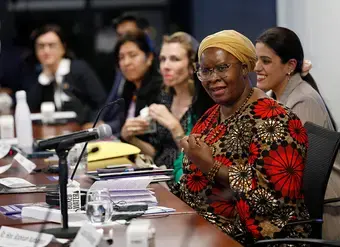
Pritha Chatterjee, from Breakthrough, India, speaks at a roundtable during the Beijing+30 Review event in Bangkok, Thailand.
Pritha Chatterjee, from Breakthrough, India, speaks at a roundtable during the Beijing+30 Review event in Bangkok, Thailand. Photo: UN Women/Ploy Phutpheng

What works to prevent violence against women and girls in local communities

“Violence and discrimination start early in the lives of girls, and it starts with the family and then the ‘school’ - where (girls) spend up to 6 hours a day,” says Chatterjee, speaking with UN Women during the Asia-Pacific Ministerial Conference, where regional leaders reviewed the progress on implementation of the Beijing Declaration and Platform for Action.

“Gender equality and quality education are inextricably linked,” says Chatterjee. “By working with young people and adolescents, we want to bring a generational shift to discriminatory norms.”

Breakthrough is advocating for creating a “gender transformative education system”, which is a whole-school approach, working with students, teachers, school administration and policy makers.

“In such a system, everyone would be safe, boys would not be favoured above girls, and girls would not be pulled out of school to work at home,” explains Chatterjee.

Chatterjee believes that such education systems can ultimately change social norms, reduce gender-based violence, and promote women’s leadership.

Breakthrough is a co-lead of the Generation Equality Action Coalition and has been a grantee of the UN Trust Fund to End Violence against Women, managed by UN Women. In 1996, the UN General Assembly resolution 50/166 called for the establishment of the UN Trust Fund in response to the commitments made in the Beijing Declaration and Platform for Action. By 2028, Breakthrough aims to reach 4 million adolescents across 35,000 schools in India.

“Another critical action that has been impactful in addressing violence against women and girls is using pop culture and storytelling to change gender norms and narratives,” Chatterjee adds. Breakthrough also works to build awareness among digital content creators and young advocates to create a “feminist internet”.

Small changes make big impacts in preventing violence against women and girls

Gender equality is a shared goal, and everyone has a role to play. Chatterjee narrates a story to show how empowering young people can make tangible differences in local communities.

“Anchal joined Breakthrough’s school-based intervention for adolescents and became a youth leader,” shares Chatterjee. “She learned to speak out against sexual harassment in public spaces – a taboo topic for many adolescents and young women. Her elder sister had never reported the incidents she experienced or witnessed, fearing that her education may be disrupted, or worse, that she would be blamed.”

“The first time Anchal raised the issue with her parents, her parents responded with disbelief and said, ‘your elder sister never faced such incidents… why are you being targeted?’”

“Equipped with the skills and knowledge gained through the Breakthrough programme, Anchal knew she had to do something. Together with her school group, Anchal approached local officials and was able to convince them to install lights and CCTV cameras in areas that women and girls identified as being unsafe.”

Consequentially, incidents of harassment reduced, and girls in her community are now more confident about speaking out against violence.

The role of civil society and feminist organizations in fulfilling the vision of the Beijing Platform for Action on ending violence against women

The Beijing Platform for Action recognized the power of feminist movements and civil society in shaping policy and supporting survivors. Research confirms that the presence of a strong and autonomous feminist movement is the most critical factor to drive change in ending violence against women and girls. Yet, in 2022, countries spent less than one percent of development aid to address gender-based violence, and only a fraction of that reached women’s organizations.

For Chatterjee, the issues that the Beijing Platform for Action committed to address are as relevant today as they were in 1995.

The role of civil society and feminist organizations is significant, she says, in “developing accountability mechanisms, amplifying and creating strategic messaging for different stakeholders to advance the agenda of gender equitable development, and advocating for feminist policies and gender transformational approaches with government and decision makers.”

“Diminishing funding for feminist networks and women’s’ rights organizations make it difficult to host in-person meetings and participate in regional and global processes,” she adds.

Chatterjee’s vision for all women and girls is powerful: “Let's create a world free of violence, where they would reach their full potential and not struggle just to fit in.”

Get involved: For ALL Women And Girls

The world cannot wait for another 30 years to fulfill the promise of gender equality. Today we stand stronger, more united, more diverse, and determined to become the first generation to achieve gender equality.

On the 30th anniversary of the Beijing Declaration and Platform for Action, join UN Women’s global campaign #ForAllWomenAndGirls.
Read more
Image
For ALL women and girls web banner

Explore 30 years of action for women's rights

4
6
Image of a woman with her thumbs up
Announcement

International Women’s Day 2025 – For ALL women and girls: Rights. Equality. Empowerment.

20 December 2024
Image
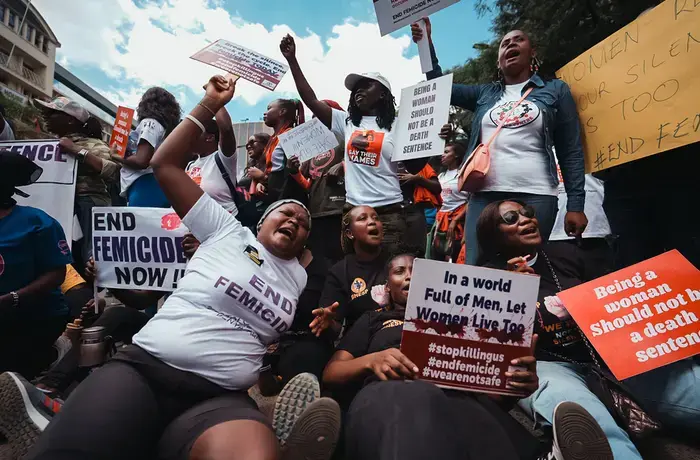
Women participate in a protest against femicide in Kenya in January 2024. At least 500 women and girls have been murdered in Kenya since 2016, despite the country's efforts to prevent gender-based violence.  Photo: William Kane Olwit
Explainer

The Beijing Declaration and Platform for Action at 30, and why that matters for gender equality

24 January 2025
UN Women Deputy Executive Director Nyaradzayi Gumbonzvanda speaking at the high-level Generation Equality dialogue on the margins of the Summit of the Future, hosted by UN Women on 22 September 2024. Photo: UN Women/Ryan Brown
Interview

Women’s rights then and now: “We have the power to transform the world” - Interview with Nyaradzayi Gumbonzvanda

22 January 2025
Sandra Aguilar participating in the Global Summit of Children and Youth for Biodiversity in the framework of COP16.
Interview

For ALL Women and Girls: Sandra Patricia Aguilar Carabalí believes that women’s leadership is key to protecting Colombia’s environment and peace

22 January 2025
Image
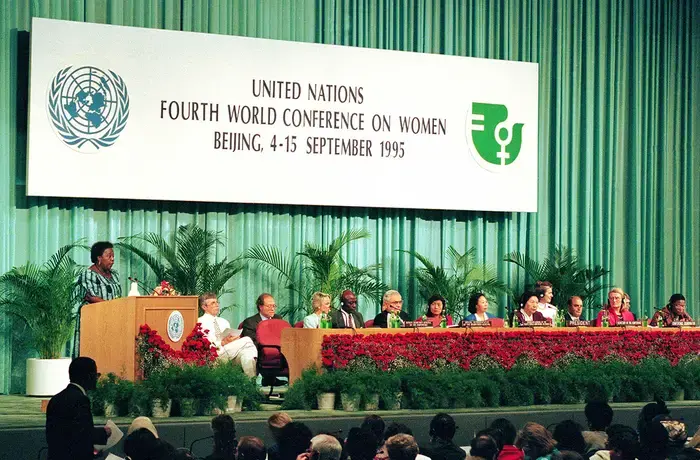
Gertrude Mongella (left, standing at the podium), Secretary-General of the Conference, addresses the session on 04 September 1995.  Photo: UN Photo/Milton Grant
Explainer

The Beijing Declaration and Platform for Action at 30: How it transformed the fight against gender-based violence

25 November 2024
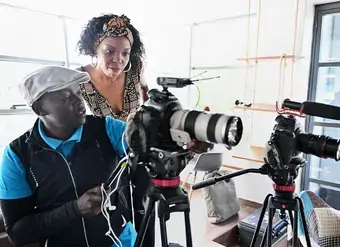
Adelle Onyango (in brown) interacts with a guest during a shoot for her Legally Clueless podcast in Nairobi.
Interview

For ALL Women and Girls: Adelle Onyango on the power of women in media

22 January 2025

Topics

  • Ending violence against women and girls
  • Anti-violence interventions
  • Domestic violence/interpersonal violence
  • Social norms
  • Intergovernmental processes
  • Beijing Platform for Action
  • Asia and the Pacific
  • India

Footer menu-HQ

  • News and stories
  • Resources
  • What we do
  • How we work
  • Where we are
  • Partnerships
  • Employment
  • Procurement
  • Contact us
  • Executive Board
  • Commission on the Status of Women

Donate button menu [Footer tablet]

  • Donate

Donate button menu [Footer]

  • Donate

Social media menu

  • Facebook
  • Twitter
  • LinkedIn
  • Flickr
  • YouTube
  • Instagram
UN Women - For all women and girls

Footer bottom [Menu]

  • Copyright
  • Information security
  • Privacy notice
  • Report wrongdoing
  • Terms of use
Share this page
  • Share to Facebook
  • Share to Twitter
  • Share to LinkedIn
  • Share to E-mail

Or copy link