Women’s rights then and now: “We have the power to transform the world” - Interview with Nyaradzayi Gumbonzvanda
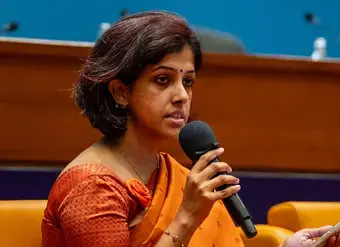
#ForAllWomenAndGirls is a rallying call for action on the 30th anniversary of the Beijing Declaration and Platform for Action. Nyaradzayi Gumbonzvanda from Zimbabwe, UN Women Deputy Executive Director, reflects about her experience at the Fourth World Conference on Women in 1995 and how the Beijing Declaration and Platform for Action remains relevant today.

The Beijing Declaration and Platform for Action - a journey for equal rights, equality, and power
“For many of us who went to the Fourth World Conference on Women, the Beijing Declaration and Platform for Action was for a lifetime. We knew that for the rest of our lives we would be struggling for these issues.”
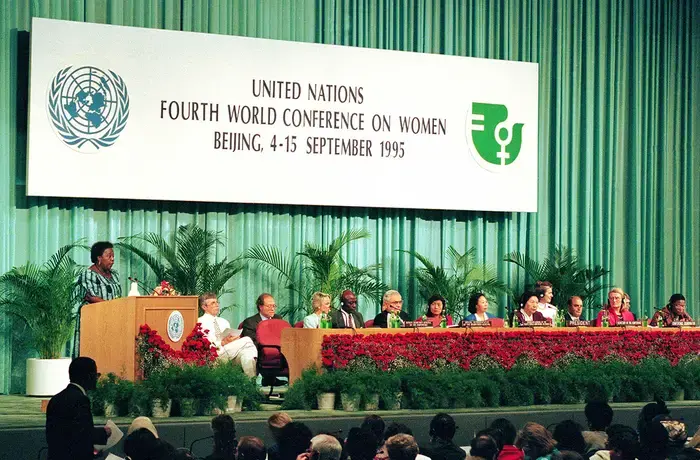
Nyaradzayi Gumbonzvanda was in her twenties when she went to Beijing, China, to attend the Fourth World Conference on Women in 1995. She was among the more than 30,000 civil society activists and 17,000 delegates who advocated, deliberated, and endorsed the resulting agreement adopted by 189 governments – the Beijing Declaration and Platform for Action. It is the most progressive and widely endorsed blueprint for women’s and girls’ rights worldwide.
Gumbonzvanda was excited about the opportunity to attend the conference, but first, she had to find childcare for her two little girls.
“The Beijing journey, then and now, was/is not just a bureaucratic exercise,” insists Gumbonzvanda.
“For feminists, it was and still is, a journey to fulfill their deep-rooted expectation that women’s rights are human rights and women and girls want to be treated equally.”

Photo: UN Photo/Milton Grant
What was significant about the Fourth World Conference on Women and how did the Beijing Declaration and Platform for Action change the women’s rights agenda?
Reminiscing about the moments that stood out for her younger self, Gumbonzvanda says, “I remember the women from the Pacific, they always had flowers. I met Black women who were not from Africa, and we were in a global meeting of women where we could speak in our own languages, not just in English.”
“What stood out for me most was understanding the world of women in all their diversities; that we faced the same issues of discrimination, and our potential and experiences were not informing the decisions. I understood that in our individual and collective efforts we could make a big difference. We have the power to transform this world.”
The 1995 Fourth World Conference on Women in Beijing was a culmination of many years of organizing by feminists, explains Gumbonzvanda. “We had met in Copenhagen for the Second World Conference on the Status of Women (1980), where we advocated for social justice and women’s position in the society. We had met in Vienna, for the World Conference on Human Rights in 1993, where the women of the world declared, women’s rights are human rights – which was then reiterated at the conference in Beijing. We had also just met in Cairo for the International Conference on Population and Development (1994), discussing about women’s sexual and reproductive health and rights. The women’s environmental movement was also very strong.”
“If you look at the language in the Beijing Platform for Action, it carries the ethos of all these issues.”
Women’s rights are interdependent
“The Beijing Declaration and Platform for Action embodied the notion of interdependence of rights – if I have the right to education, it means I have ability for political participation. If I am in decision-making, I can influence the economy. When we invest in ending violence against women, we may see results in women’s stronger economic participation.”
While the Fourth World Conference on Women drew in a rich diversity of women and feminists from all parts of the world, Gumbonzvanda admits that participation was not easy for all women. China was far, and getting a visa, funds to travel, or even knowing how to access information was not easy. Language was a barrier even then, as it is now, because not every meeting could afford translation.
Representation matters
“Simply being present, in and by itself, is so crucial,” says Gumbonzvanda. “The conference in Beijing was led by Gertrude Mongella (Member of Parliament of Tanzania and a UN diplomat). To see Mama Gertrude Mongella sitting there moderating sessions was inspiration for us.”
“It showed us that it was possible to take leadership. The world of possibility was created.”

What were the major achievements of the Beijing Declaration and Platform for Action and what are some of the challenges today for women’s rights?
“The number of women’s organizations that were strengthened and created after the Beijing Declaration and Platform for Action was very exciting,” shares Gumbonzvanda. “The conference was an impetus for organizing and mobilizing.”
Organizing and funding for women’s rights
“The collective power of women became very visible at the Beijing conference,” she adds. “And out of that, came the strong sense that the women's movement needs to find creative ways of self-resourcing and financing the feminist agenda.”
“Today, there is much more bureaucracy, limiting women’s participation.”
“Accountability everywhere is very important, but there needs to be space for self-organizing,” she explains. “Some of the strong community-based organizations continue to do their work but may not be getting the funding, because the thresholds for accessing funding have become very sophisticated, complex, and tech-based.”
According to the UN Secretary-General’s report, less than one per cent of development aid goes to organizations advocating for gender equality.
Traction for ending violence against women and women’s role in peace
An issue that received prominence at the conference was violence against women. “The following year, in 1996, the UN General Assembly adopted a resolution calling for the establishment of the UN Trust Fund to End Violence against Women,” shares Gumbonzvanda.
UN Women manages the UN Trust Fund, which has awarded USD 225 million to 670 initiatives to address and prevent violence against women and girls in different parts of the world. The Beijing Declaration and Platform for Action also led to a significant increase in laws to address domestic violence, enhanced services for survivors, and improved data collection on violence against women.
Gumbonzvanda reflects about the impact of the Beijing Platform for Action on women affected by conflict: “There was a big push for the issue at the conference, and the advocacy continued after. In the year 2000, the UN Security Council adopted the Resolution 1325 on Women, Peace and Security (UNSCR 1325), and that’s how we started seeing more women participating in peace processes and mediations.”
Women’s rights and the economy
When asked about where we need more traction, Gumbonzvanda turns to the economy. “We need to reshape the discourse around women and the economy. First, we need to clarify that GDP of a country does not translate to equal opportunities for all women in that country, nor does it mean that women are living a life free of violence in that country.”
“When the GDP of low and middle-income countries increase, the Official Development Assistance reduces. We need a model of international development that supports and sustains the work on gender equality in low and middle-income countries.”
Another big area of challenge that Gumbonzvanda points to is debt. “Countries are still borrowing at very high interest rates, while they are still paying off their previous debt.” This impacts their investment in and therefore progress on women’s rights, she explains.

What are some lessons that today’s feminist movements can learn from the Beijing conference era about the pushback on women’s rights?
“The space [for women] has always been shrunk,” says Gumbonzvanda.
“I was born in the colonial era in my country. For some people, the space had never existed fully, then and now. Patriarchy has always existed, and it has circumscribed the space for women.”
“Women didn’t have the right to vote in many countries in our recent history, they couldn’t open a bank account, or own land. There are shrinking spaces in migration – the rules about who can go where are shrinking.”
“The space we have today has been struggled for. We cannot take it for granted.”
Gumbonzvanda also stresses that the pushback on women’s rights is happening within a context of global insecurities.
“The Beijing Platform for Action is about life,” she says. “It is not about who has the last word during a political negotiation. It is about the lived experiences of people right now – someone experiencing discrimination now, being violated, or having limited opportunities now. We should not lose the essence that this is about people.”
Gumbonzvanda takes this principle to her conversations with governments as they review the progress of implementation of the Beijing Platform for Action, 30 years later. “When Member States are negotiating, my single ask is, what is the right decision to protect the well-being of our people, to support our people to live in dignity,” she says.
“The world today needs dignity and empathy, inclusion and non-discrimination. How do we achieve that?”
“As we did in Beijing, we need to say what we mean. When discrimination happens, we need to name the grounds of discrimination, because naming is knowing, and in naming, we identify where the problems lie, and we find solutions.”
Get involved: For ALL Women And Girls
The world cannot wait for another 30 years to fulfill the promise of gender equality. Today we stand stronger, more united, more diverse, and determined to become the first generation to achieve gender equality.
On the 30th anniversary of the Beijing Declaration and Platform for Action, join UN Women’s global campaign #ForAllWomenAndGirls.